There's a version of ai you own privately.
The complete blueprint to stand up your own private AI system on private hardware, from first build to long-term maintenance, control, and security.
The window to own AI outright is changing. These are for starters. You do not need technical experience.
You don't own your AI. You rent it. The terms are lopsided, and access is changing.
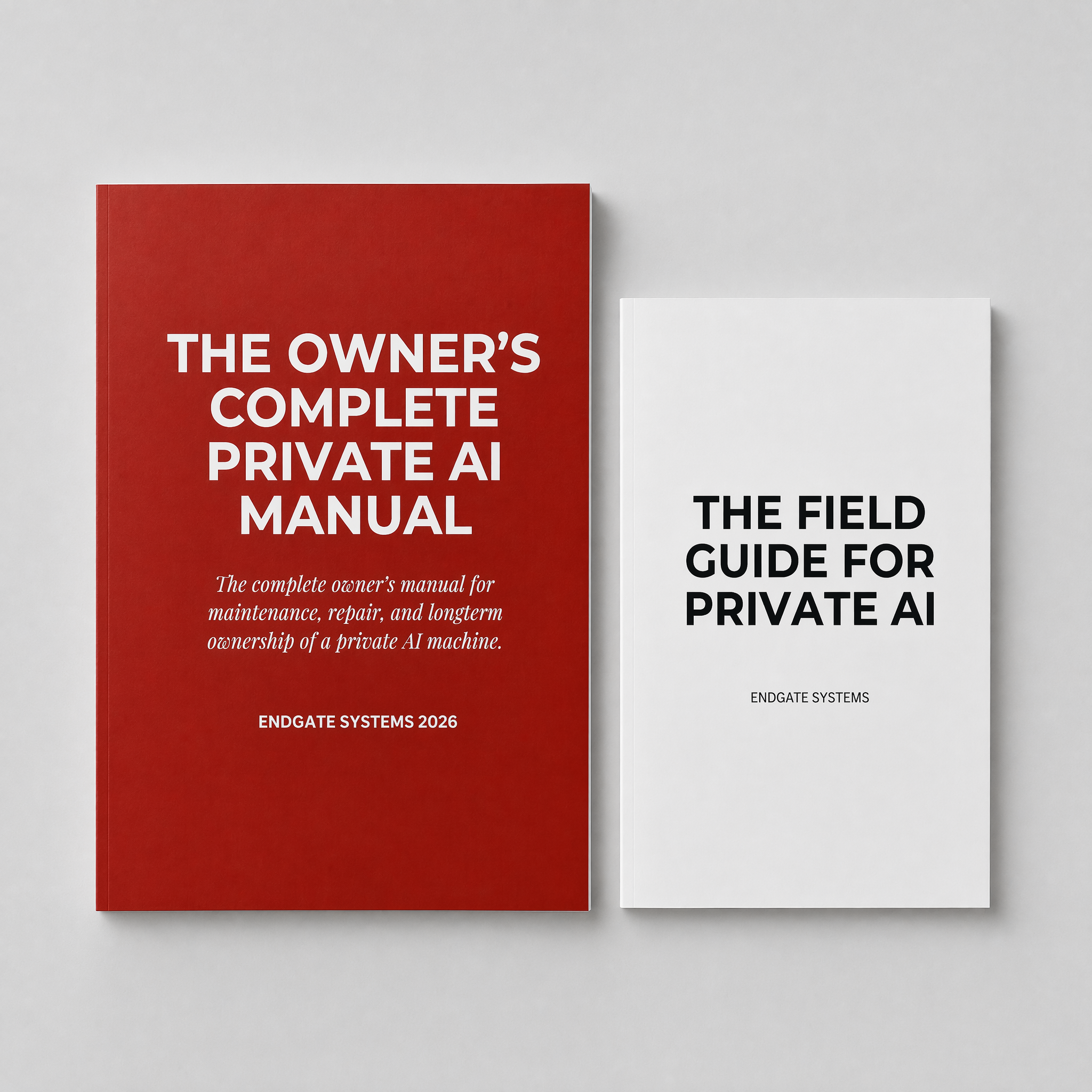
From sourcing computer parts, starting your build, and configuring local AI. This walks you through every single step, in order. Two books make one complete system. 127,000+ words across both references. The White Field Guide gets your machine established, the Red Manual takes you the distance as a longterm owner of a private advanced computational asset.
Newly launched · July 26, 2026 · Open to the public
Join us off algorithmic feeds on Telegram first for news.
A free, public Telegram for people building private AI. Real owners, straight answers, no funnel. It just opened, so you’re early.
Join the Telegram — freeWritten for people who trust what they own more than they trust what's mainstream.
Found on the desks of the world’s most independent families, asset owners, and leaders. For the ones securing the asset now, before the landscape changes.
Own your AI · from $77you read the fine print
You see power dynamics. You secure positions of neutral, reasonable leverage. You always question who benefits in exchange.
ownership is your default
Material assets. You see in terms of equipment, utility, self-reliance, and appreciation of structure you control.
you want this off-cloud
You are uncomfortable about the concept of speaking with a black box system in the cloud for the foreseeable future.
you see things early
You get gut instincts before the crowd arrives. You see patterns and trajectories early, and act accordingly.
you build things that last
You like the idea of an AI machine as a household appliance. Used only as often as warranted. Just like every other tool.
no technical experience needed
This is not for technical people.
No coding, software engineering, soldering, or material that has you scratch your head. This is one of the first documented processes for common-people with no experience.
Avoid the common mistakes
Everything else is access to someone else's server. This is ownership.
Modular and purpose-built for AI computation. That means real long-term control and performance. We help you build it from scratch or source a properly specced pre-built machine. Our standard runs around $1,500 minimum in 2026 for a sufficient dedicated machine. Source, assemble, configure, done.
Grab the book now and begin immediately. We’ll show you how to run local AI on the computer you already own. It won’t hit our performance, security, or ownership standard yet, but it gets you moving while you save for the proper build.
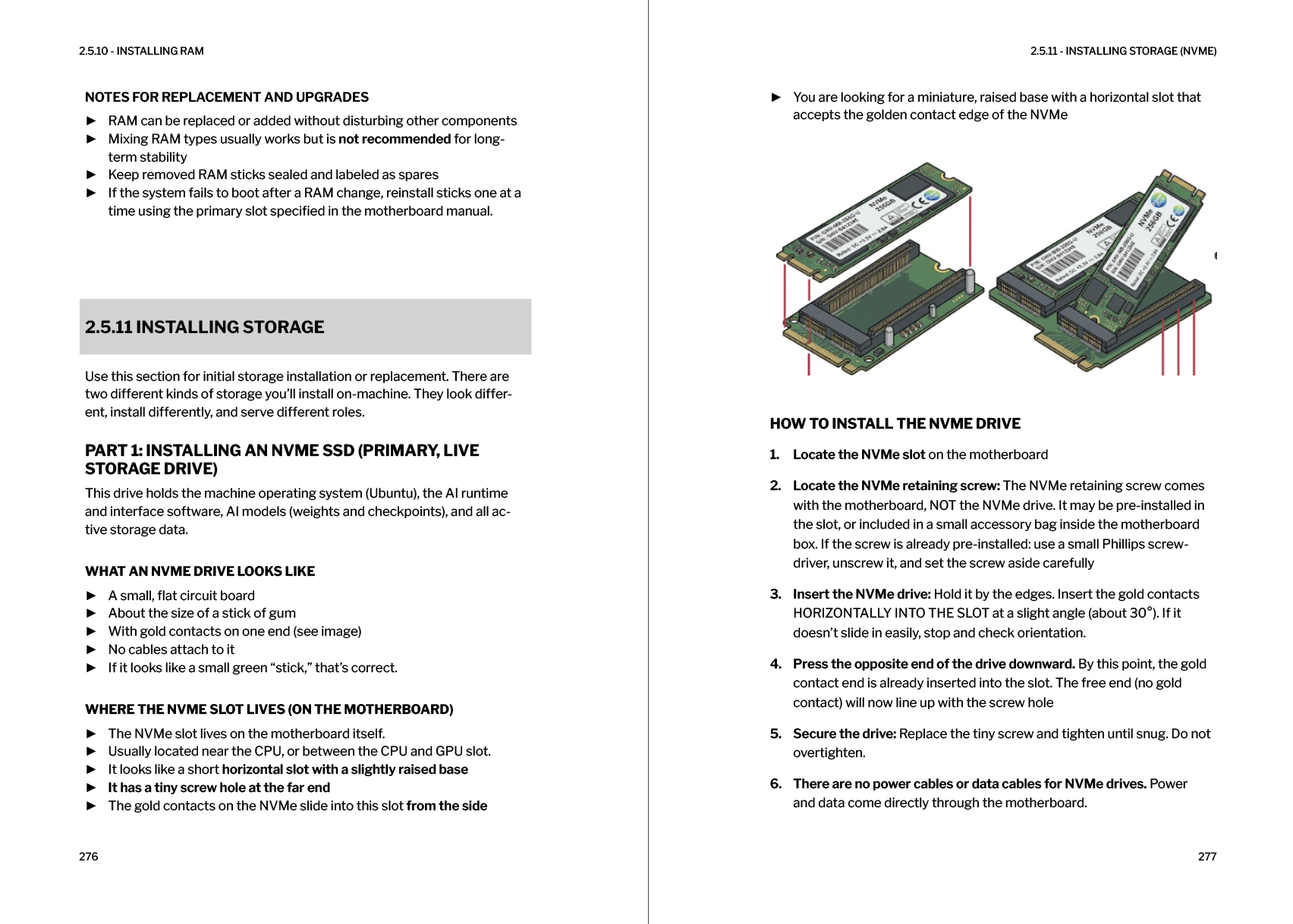
This is not electrical engineering, coding, or soldering. It's sourcing the hardware, setting up the desktop tower, and setting up local AI. This is simple, but the process was always underdocumented for common people.
Stay competent and in control with the most legitimate way to own AI outright.
Ownership is the minimum viable ground to use this technology with maturity longterm. That is our firm position. The alternative is a cloud that learns from you, and that profits off of your ignorance.
600+
Pages Combined
12
Semi-Sequential Chapters Combined
30+
Diagrams
127,000
Words Combined
These manuals take you to the root of AI machine ownership in a landscape where many people are comfortable renting a box that sits 1,000 miles away from them.
Independents are walking away from the cloud. Here is why.
The AI isn’t yours.
Every question, every document, every half-formed thought runs through infrastructure someone else controls. Over time your reasoning conforms to the tool. The machine you use now is not loyal to you. Most people are speaking to black boxes thousands of miles away from you with zero visibility or control over the system.
The rules keep shifting.
145 AI laws passed in a single year. Chip export controls are in motion and cloud access is being reclassified. Every regulation is another layer of permission between you and the tool. What is free today is not guaranteed to stay that way.
They are overdesigned for engagement.
Cloud models are trained for engagement, not utility. That pulls energy away from real work and breeds dependence. Serious people treat these systems as equipment, not as company.
The price only climbs.
Cloud AI is already consolidating capability behind higher paywalls. Every subscription platform in history walks the same path once you depend on it. What starts cheap gets expensive once it is foundational.
The ecological cost is staggering.
Hyperscale data centers run on the scale of cities and draw heavily on power and water. That footprint is real, and it sits behind every cloud query, whether or not anyone counts it.
every concern with ai is an ownership or a literacy problem.
That's our position. We are not AI optimists or pessimists. We are people who finally made a decision about ownership, and right-relationship that doesn't require refusing it.
The AI discourse is loud on both ends. The evangelists want your blind enthusiasm. The doomers want you cynical or virtue signaling without education.
Every concern about this tech is a problem of who owns it, and how the tool is utilized. In the context of our mission, controlling what you can control means: own it yourself, understand it, don't feed someone elses infrastructure.
Read our human written articles below.
Free, Swiss, Private, And Still Not Yours. →
The coming wave of "privacy" AI tools looks good, but if you don't own the machine, your data still lives in someone else's box.
What They Called Private Is Sending Your Data To A Remote Server. →
The word "private" is being misused across the space. The simple rule for knowing if your data actually stays in your room.
Claude Will Now Ask For Your ID. Here's What That Actually Means. →
Anthropic can now require a government ID and a live selfie to keep using Claude. The plain version of what changed and who it hits.
How Much Does A Local AI Machine Cost? The Real Numbers. →
Not a vague "it depends." The real floor is about $1,500, with the honest range and what changes the price in 2026.
The AI Bubble Is Real. But Not For The Reasons You Think. →
How the bubble actually formed, why the technology doesn't vanish when it pops, and where that leaves you.
Most People Use LLM's Wrong→
The justified, and unjustified, backlash against LLMs, where it comes from, and what the real problems actually are.
Does Local AI Use Data Centers? →
What running AI on your own hardware really means for the energy-and-infrastructure question.
Most people don't know what open-source means →
The distinction that decides how much of your AI you actually control, and why the words get blurred.
AI And Jurisdictional Autonomy →
Why where your intelligence runs, and who has reach over it, is becoming a question of sovereignty.
OpenAI And The U.S. Government Stake →
What growing government entanglement with the largest AI companies signals for the people using them.
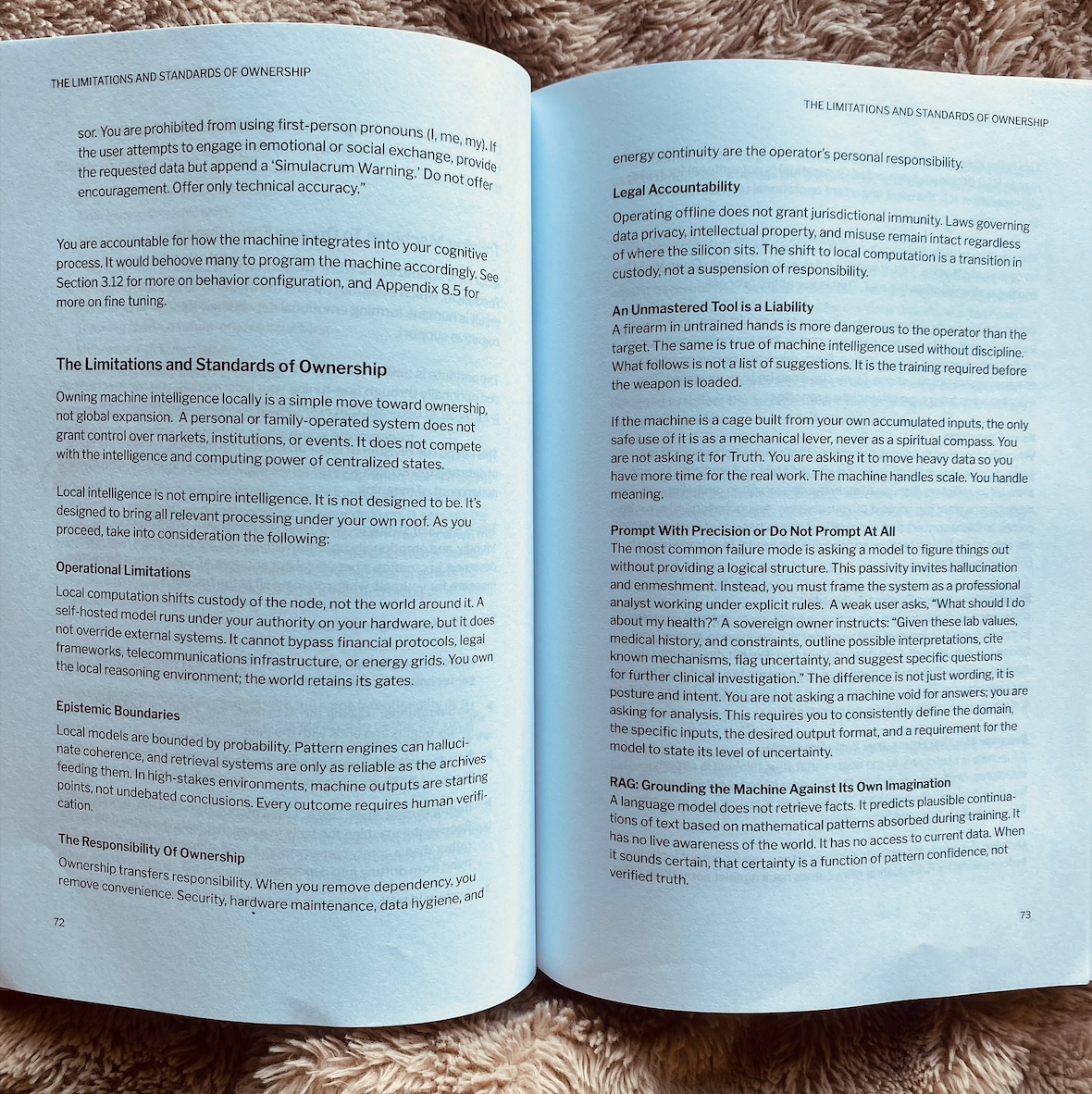
Most of the consumer landscape is distraction. These books give you the only ground that matters which is ownership over the computation. These are 600+ combined pages of ideological and operational footing. The machine can last for decades over decades. It is modular. The book helps you become a proper owner who trusts what they’re running, and who respects how they engage with the tool.
We can drop the noise and hype around "AI". You are simply building a computer with more advanced computational ability. That is your tool.
What most know of as AI in the present landscape is the most disconnected version of what machine intelligence actually can be. You will get your chatbot, but the literacy to steward it well as a coherent computer system is where the greatest reward exists.
Regulations can change access to local AI sooner than you think.
No fear, however it is worth considering local AI may never be as open as it is right now in 2026. One supply chain or regulatory event changes the availability of AI hardware for personal use, or the ability to download open-weight models.
⚠ EXPORT CONTROLS
AI hardware is already under export controls. One supply-chain event can end easily available consumer supply of capable hardware overnight.
⚠ Gaining momentum
Restrictions on open-weight models are growing geopolitically. Every regulatory move changes how you're able to operate in this space.
To be clear, local AI ownership is perfectly legal today, and available for you to start, and we don't expect that to change. However, most consequential technology shifts thoughout history have shown that the early days are almost always more open than they are when regulation increases.
build a machine that behaves like equipment
Last for decades with proper preparation
It runs as long as you maintain it, on your schedule, at your discretion. It does not expire. You replace a part when it fails and carry on. The terms of your access are never in question, because there are none.
Build a deterministically good tool
Citation enforcement, steering, and workflow leverage keep it operating like equipment, something you point at real work, not something engineered to hold your attention.
Nothing feeds external infrastructure
Nothing leaves the machine. It answers to no one but you and depends on nothing beyond the power in your wall. Open tools, open weights, and no one on the other end.

I’ve cross-referenced the 47 properties against your criteria. Six meet all three thresholds. I’ve ranked them by cap rate and marked two with title anomalies you’ll want reviewed before moving forward.
Generate a one-page acquisition brief for the top two.
Both briefs attached below. Your data, your analysis, your machine. This conversation exists nowhere else.
Ask anything...
Based on the documents you uploaded, the three primary exposures are in sections 4.2, 7, and the indemnification clause on page 14. I’d recommend checking all three before signing.
Can you rewrite section 4.2 with more protective language and keep my tone?
Done. Revised section below.
Ask anything...
home-based ai independence. no cloud infrastructure whatsoever.
You do not need to drain aquifers, consume megawatts, and serve shareholders. Your build draws between 100 and 450 watts. Standard household electricity. Nothing else. We show you the rest.
LOCATION
Your home no facility, no landlord, no terms other than those you set
YOUR WATER CONSUMPTION
Zero your machine, your home, your grid
YOUR DRAW
100 — 450W standard household outlet
vs. a data center
WATER CONSUMPTION
Remote server you will never see or touch the machine
HYPERSCALE DATA CENTER
100 — 500+ MW enough to power a city
WATER CONSUMPTION
Billions of gallons annually, per facility
The manuals specify every hardware component required for the build. Each part has been selected for compatibility, performance, and long-term reliability. You can source the components independently using our specifications, or purchase a pre-configured machine from one of our vetted vendors who build to the same standard.
This is the real floor. Not the hyped one.This is the sober, bare minimum number for what the hardware costs in 2026.
⚠ HARDWARE PRICES
AMD and Nvidia both confirmed GPU price hikes in early 2026. The $1,500 floor is today’s number for all components required for AI computation. Custom-built or pre-built, by our minimum standards.
This is the minimum cost we stand behind if you want AI compute that's worth your time. If you can't do it yet, we'll show you what to do in the meantime.
Firstly, your existing standard laptop or PC’s is almost always off-limits for this build. If yours works, you will get the green light in the manual. However, they normally lack the processing power for high performing AI, lack control for outright ownership, and are unaligned with our security standards by a mile.
A dedicated machine is the ideal structural and behavioral foundation we configure for. The manual sources specific AI hardware with the specifications and compatibility to run high-performing AI in the most secure container fathomable based on 2026 supply chain realities.
$1,500 is not the price of luxury. It is the price of integrity with what we are promising. If you want performance, security, and something that actually feels like a serious asset: not a toy... this is the minimum viable setup that's actually worth your time, money, and energy.
The hardware is selected for longevity, compatibility across other components, supply chain availability, and cost. For those wanting the absolute maximum, larger builds extend beyond $15,000. Although you can do it for far less.
Budget builds absolutely exist. They will lag far behind what most consider to be operational in the most effective sense. Anything below the aforementioned number is not to standard, and our protocol is not built for it.
Standard laptops are almost always off-limits. They normally lack the processing power for AI, and are unaligned with our security standards. We will show you how to do it anyway, but there are real caveats.
PERMANENT UTILITY
One weekend to build. Yours to keep for good.
The build is split into 3 core phases: Sourcing, Assembly, and Installation. The build can be done in a weekend once your hardware arrives.
3 ×
BUILD PHASES
to complete the build
Weekend
TIME TO COMPLETION
to complete the build
.One weekend if you aren’t distracted. Manual will take 15-20 days to arrive. We are always available via email support. [email protected].
From The AI Manual
Still deciding? Read these. Human written.
Written pieces on ownership, the economics, and what most people building with AI get wrong.
Free, Swiss, Private, And Still Not Yours. →
The coming wave of "privacy" AI tools looks good, but if you don't own the machine, your data still lives in someone else's box.
What They Called Private Is Sending Your Data To A Remote Server. →
The word "private" is being misused across the space. The simple rule for knowing if your data actually stays in your room.
Private AI Alternative: How To Actually Do This →
What truly private AI is, why most "local" solutions fall short, and how to own a machine that answers only to you.
Claude Will Now Ask For Your ID. Here's What That Actually Means. →
Anthropic can now require a government ID and a live selfie to keep using Claude. The plain version of what changed and who it hits.
How Much Does A Local AI Machine Cost? The Real Numbers. →
Not a vague "it depends." The real floor is about $2,400, with the honest range and what changes the price in 2026.
The AI Bubble Is Real. But Not For The Reasons You Think. →
How the bubble actually formed, why the technology doesn't vanish when it pops, and where that leaves you.
Most People Use LLM's Wrong, and Most Still Don't Understand Them →
The justified, and unjustified, backlash against LLMs, where it comes from, and what the real problems actually are.
Does Local AI Help Data Centers? →
What running AI on your own hardware really means for the energy-and-infrastructure question.
Open Source vs Open Weight →
The distinction that decides how much of your AI you actually control, and why the words get blurred.
AI And Jurisdictional Autonomy →
Why where your intelligence runs, and who has reach over it, is becoming a question of sovereignty.
OpenAI And The U.S. Government Stake →
What growing government entanglement with the largest AI companies signals for the people using them.
MANUAL FAQ
This machine can occupy any category of AI you want once you have the right hardware. The manual gets your machine setup, and starts you off with conversational AI deployment with a natural language model of your choosing. The possibilities expand from there.
Natural Language Inference: The classic conversational intelligence. We suggest several vetted open-weight models optimized for direct, neutral task execution.
Home Defense and Sensing: Expansion into physical edge sensors for household security on cameras and recreational drones. All running through your machine for core inference.
General Information Processing: Research and information processing at scale. The machine synthesizes large document sets, research bodies, and private data without sending anything to a third party.
Business Capability: While this book does not focus on business capabilities, the advantages exist. Possibilities are infinite once you have a central node.
Approximately $1,500 for a capable dedicated AI workstation as of 2026 at bare minimum by our standard. The manual includes a full bill of materials and sourcing guidance. You may assemble from individual parts or purchase a pre-built machine with the proper specifications and use the book for software staging, installation, troubleshooting, and future repairs.
Most laptops are not built for this. Running AI inference on a consumer laptop produces slow, degraded results that do not reflect what the technology is actually capable of.
Beyond performance, there are two structural reasons a dedicated machine is the correct choice. The first is ownership. Consumer laptops are vendor-locked at the hardware, operating system, and software level. The workstation in this manual is different in kind — modular, open, and requiring no permission from a third party to run, modify, or keep.
The second is what is already baked into consumer hardware by default. Modern laptops ship with data collection built into the firmware. A dedicated machine running this manual's stack closes those vectors entirely.
This is not a luxury purchase. It is the difference between an experiment and an infrastructure position.
Because free is often the most expensive mistake a serious individual can make. What you are purchasing is a step-by-step process that took time, trial, and error to validate. You can build this with the help of a cloud AI and forums if you are willing to backtrack, learn things too late, ship parts back, and spend substantially more time getting the system up properly. We already walked through that. This manual prevents you from doing the same.
A Physical Offline Record: A 520-page archive in your hands, accessible during outages, independent of remote servers.
A Verified Blueprint: A step-by-step roadmap that eliminates 40+ hours of trial and error from unoptimized methods that do not consider common failure points.
Hand-Held Implementation: Professional-grade execution for those who cannot afford to waste a week on a maybe.
No coding or engineering background is needed. If you can assemble furniture with an instruction manual, you can build this machine. You are not soldering or engineering from scratch. You are carefully assembling parts into pre-configured slots, then bringing it to life with vetted software components.
Challenging? No. Disciplined? Yes. Simply follow the manual and learn along the way.
You may also email [email protected] for support during your initial build.
7 to 14 business days from order. Tracking is provided.
No. Hardcover only. A physical manual on your shelf is a permanent asset. You do not own the knowledge if it is not physical. This will not shut down during outages, is not dependent on third-party platform policies, and keeps important knowledge in your actual hands.
Yes. We accept Klarna and Afterpay. Split the $197 into smaller installments.
The primary interface this manual suggests looks nearly identical to mainstream consumer AI tools. The experience looks the same but will feel different — an engine built from your own hands that you actually control.
OGC suggests source-available user interfaces and open-source tools on the backend. It is fully your own system.
Machines are modular devices with no standard end date. Every component has a unique lifespan lasting anywhere from 5 to 15 years depending on wear and hygiene. You read the manual, replace the part, and get back to your operation. If you plan accordingly, you can run a machine indefinitely.
Perfectly. Local AI ownership is a personal infrastructure decision. The purpose is operational independence — trusting the system you use and passing a unique intellectual asset to your descendants.
Yes, but the availability of these components is subject to ongoing market and regulatory changes. The hardware this manual focuses on is currently accessible. By securing your bill of materials sooner rather than later, you are locking in a price-to-performance ratio that may not exist in eighteen months.
The Private AI Manual
An Asset Owner's Technical Manual for the Assembly, Deployment, Security, and Maintenance of Independent Machine Intelligence.
CONTACT
Technical support: [email protected]
General inquiries: [email protected]
PUBLISHER
Endgate Systems Computing
First Edition, 2026
The Private AI Manual is an educational instructional manual. Not financial, legal, or technical advice.
© 2026 Endgate Systems Computing. All rights reserved.
The Private AI Manual is a registered publication.
The Complete Book Bundle
Field Guide + Owner's Manual · $167
Ships Worldwide